

Clear Aligners vs. Invisalign: What Matters Most?
Clear aligners vs. Invisalign: Invisalign is a brand of clear aligners, not a separate type of treatment. Other clear aligners can also treat many mild to moderate alignment problems. The right choice depends on your teeth, your dentist’s treatment plan, and the full cost, including any extra trays and retainers. Neither option is automatically faster. Both generally require 20 to 22 hours of wear each day.
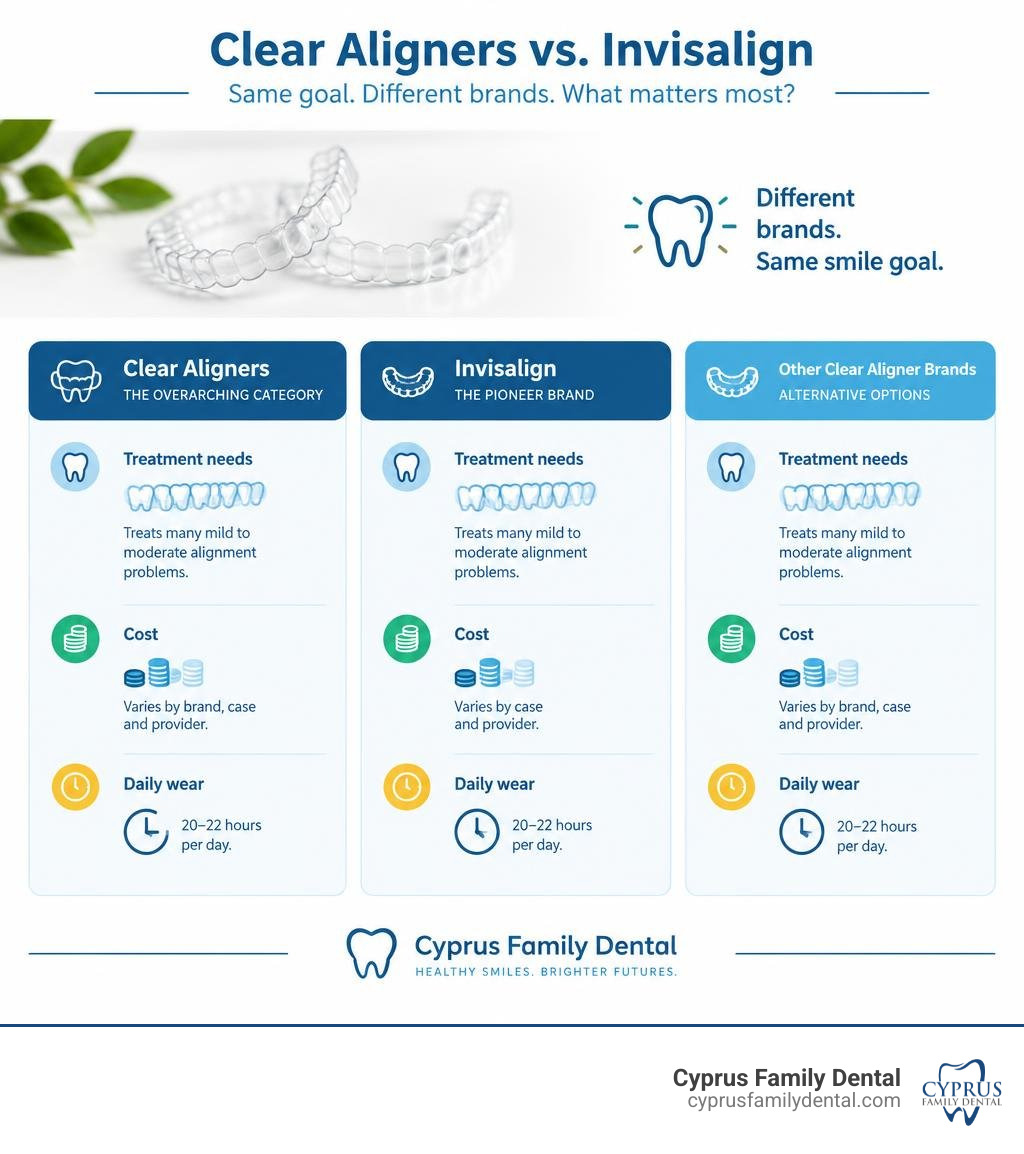
Clear Aligners vs Invisalign: Key Differences and Overview
When exploring modern orthodontic care, understanding the landscape of invisible orthodontics helps you make an informed investment in your smile. “Clear aligners” is the overarching category of transparent, removable orthodontic appliances, while Invisalign represents the pioneer brand that brought digital clear aligner therapy to the global market. Today, several alternative clear aligner systems provide competitive alternatives.
Both approaches aim to resolve malocclusions, close gaps, and straighten misaligned teeth without the aesthetic impact of metal brackets and wires. However, key engineering differences set systems apart:
| Feature | Invisalign | Alternative Clear Aligners |
|---|---|---|
| Primary Material | Proprietary SmartTrack (multi-layer polyurethane) | Dual-material options (e.g., Flex 0.625 mm & Force 0.75 mm) or single-layer PETG/polyurethane |
| Attachment System | SmartForce engineered attachments | 3D-printed pre-loaded templates or standard composite templates |
| Planning Software | ClinCheck (backed by tens of millions of cases) | Proprietary digital software suites |
| Turnaround Time | 2 to 4 weeks (international centralized manufacturing) | 1 to 3 weeks (varies by regional or domestic production) |
| Typical Cost | Higher baseline investment; comprehensive tiers | Often 10% to 20% lower laboratory fee overhead |
| Clinical Scope | Mild, moderate, and complex malocclusions | Mild to moderate cases; select complex cases with auxiliaries |
Material Technology and Tray Thickness
The mechanical performance of any aligner system hinges on material science. An aligner must exert a gentle, continuous force without degrading, stretching out, or losing elasticity over a 7- to 14-day wear cycle.
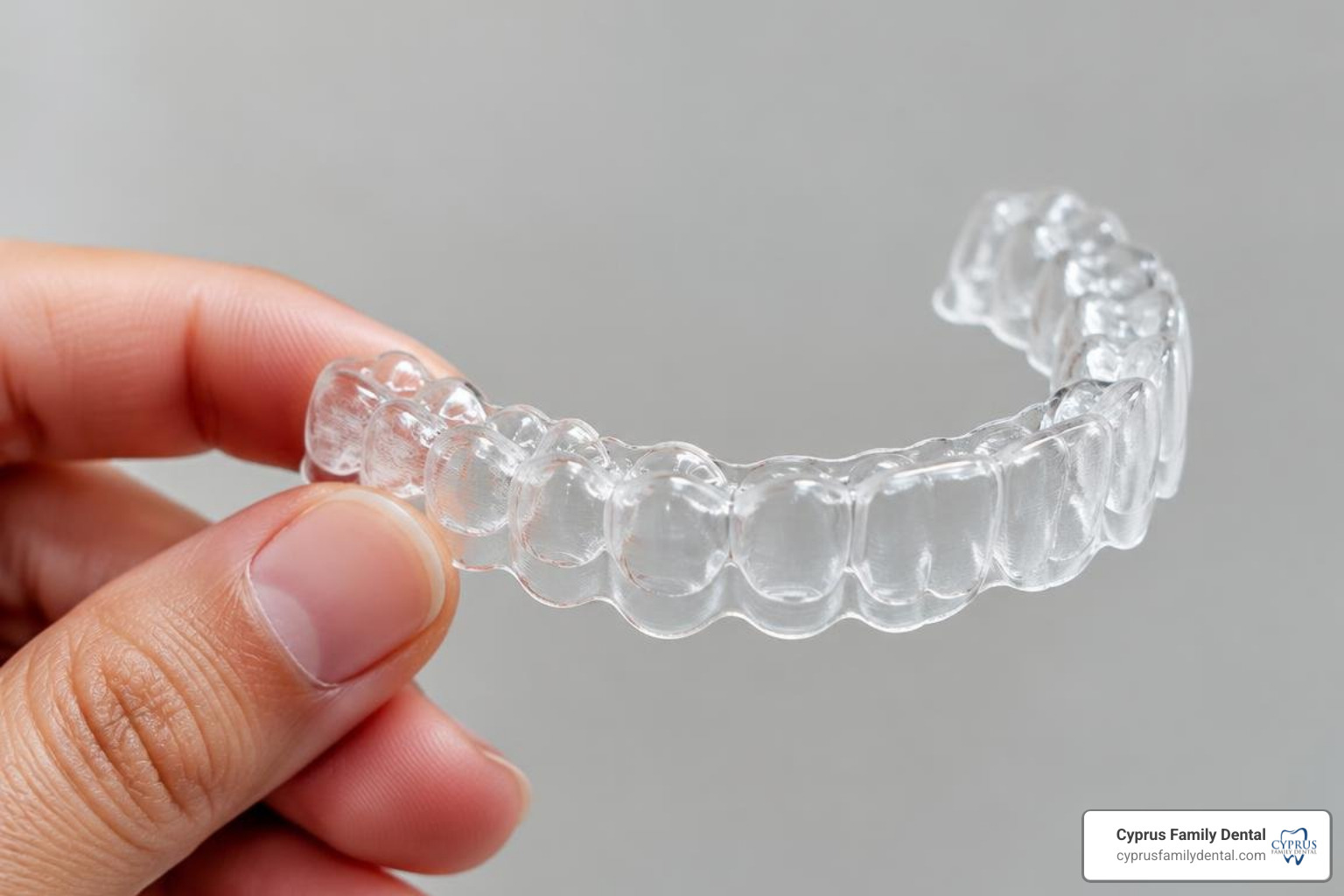
Invisalign uses its patented SmartTrack material. This multi-layer aromatic thermoplastic polyurethane is engineered specifically for orthodontic tooth movement. It delivers highly elastic, continuous forces and conforms closely to the gingival margin and tooth anatomy, providing optimal grip and torque control.
In contrast, some alternative systems utilize a dual-material strategy. Rather than using one uniform plastic thickness across the entire timeline, they alternate between:
- Flex Material (0.625 mm): A thinner, more pliable layer typically used during initial alignment phases to maximize comfort and simplify tray insertion and removal.
- Force Material (0.75 mm): A firmer, thicker plastic applied when higher biomechanical force is necessary for complex tooth rotations, root uprighting, and torque adjustments.
Other domestic aligner brands often use high-grade single-layer co-polyester or polyurethane sheets. While these materials are effective for straightforward tooth straightening, they may show slightly higher rates of stress relaxation over time compared to multi-layer engineered resins.
Attachment Systems and Bonding Efficiency
Attachments—small, tooth-colored composite buttons bonded directly to your enamel—serve as friction points and handles that allow the plastic trays to direct force vectors precisely. Without attachments, aligners would struggle to perform difficult movements like extruding a tooth or rotating round premolars.
Invisalign uses engineered SmartForce attachments, which are digitally customized based on the shape of your tooth and the exact direction of planned movement.
Alternative systems have introduced innovative workflows. For example, some feature 3D-printed attachment templates that come pre-loaded, saving approximately 12 minutes of clinical chair time during the bonding appointment. By streamlining chair time, dental teams can pass operational efficiencies onto patients while maintaining rigorous clinical precision. If you are curious about common misconceptions regarding these composite buttons and clear aligner wear, exploring our guide on debunking Invisalign myths breaks down what is true and what is fiction.
Treatment Scope, Speed, and Biomechanics
Clear aligners have evolved far beyond purely cosmetic adjustments. Today, advanced aligner therapy addresses wide-ranging malocclusions including:
- Crowding and overlapping teeth
- Spacing and generalized diastemas
- Deep overbites and underbites
- Transverse discrepancies and crossbites
- Anterior open bites
Clinical Predictability: Clear Aligners vs Invisalign for Complex Cases
The clinical success of any aligner treatment depends on biomechanical predictability. While minor alignment changes track reliably across almost all systems, complex three-dimensional movements require specialized planning.
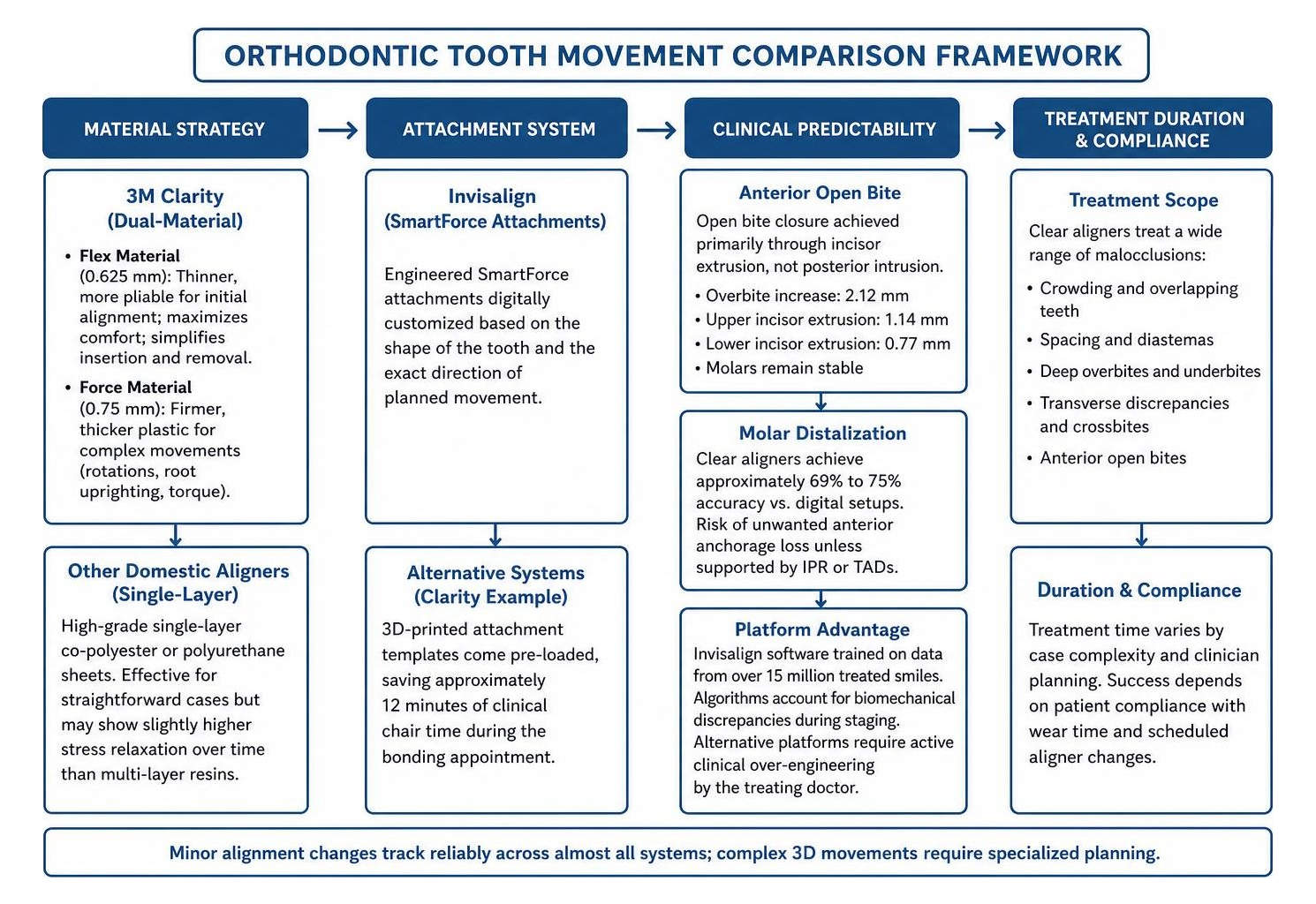
In cases involving an anterior open bite, research demonstrates that clear aligner therapy achieves closure primarily through incisor extrusion rather than deep posterior intrusion. In a cephalometric study evaluating open bite closure, aligners produced an average increase in overbite of 2.12 mm, driven by 1.14 mm of upper incisor extrusion and 0.77 mm of lower incisor extrusion, while molars remained stable (Inchingolo et al., 2023).
For molar distalization—moving posterior teeth backward to create space or resolve Class II malocclusions—predictability varies. According to a systematic review, dental distalization with clear aligners achieves approximately 69% to 75% accuracy relative to digital setups, carrying a risk of unwanted anterior anchorage loss unless supported by interproximal reduction (IPR) or temporary anchorage devices (TADs) (Inchingolo et al., 2023). Because Invisalign’s ClinCheck platform is trained on data from over 15 million treated smiles, its algorithms often account for these biomechanical discrepancies automatically during staging, whereas alternative platforms require active clinical over-engineering by the treating doctor.
Treatment Duration and Daily Compliance
Regardless of the brand chosen, clear aligner biology remains the same. Aligner trays work only when they are in direct contact with your teeth. Patients must commit to wearing their trays for 20 to 22 hours per day, taking them out only to eat, drink colored or hot liquids, brush, and floss.
Typical treatment durations follow these clinical tiers:
- Minor corrections (mild spacing or relapse): 6 to 8 months.
- Moderate malocclusions (moderate crowding or rotational issues): 12 to 18 months.
- Complex cases (severe crowding, extraction sites, or bite correction): 18 to 24+ months.
Many patients transition trays on a 7-day or 14-day schedule depending on bone density, age, and tracking accuracy. If you are considering starting treatment during a break or before a major schedule change, our team can help you map out your summer Invisalign treatment planning to keep your timeline on track without disrupting vacations.
Cost Comparison, Insurance, and Long-Term Value
Clear Aligners vs Invisalign Cost and Affordability
Cost is often a primary consideration when evaluating clear aligners vs Invisalign. The overall cost of clear aligner therapy reflects laboratory manufacturing costs, the doctor’s clinical expertise, appointment overhead, and necessary follow-up refinements.
Alternative aligner options (such as custom partner lab solutions or in-house tray systems) frequently cost 10% to 20% less than full Invisalign packages. This price difference stems primarily from lower external laboratory fees and faster local supply lines rather than differences in diagnostic skill.
To make care accessible, our office in Magna, UT, provides flexible financing options, monthly payment plans, and acceptance of Flexible Spending Accounts (FSA) and Health Savings Accounts (HSA). Learning about the lifelong benefits of Invisalign and other aligner options helps patients weigh immediate expenses against long-term oral health and function.
Insurance Coverage, Refinements, and Retention
Most dental insurance plans with an orthodontic benefit cover clear aligners under the same terms as traditional metal braces, typically offering a lifetime orthodontic maximum (often between $1,000 and $3,000). Orthodontic benefits generally apply equally whether you choose Invisalign or an alternative brand.
Key financial factors to review before starting treatment include:
- Refinement Trays: Teeth do not always track with digital simulations. Comprehensive packages usually include refinement aligners at no added charge, whereas budget packages may bill extra for subsequent tray scans.
- Post-Treatment Retainers: Once active tooth movement is complete, retainers (such as Vivera or custom thermoformed retainers) are essential to prevent relapse.
- Included Visits: Ensure your routine progress checkups are built into your single treatment quote.
Review our complete patient info for Invisalign to understand all phases of care from diagnostic records to retention.
How to Choose the Right Orthodontic System for Your Smile
Evaluating Case Complexity and Lifestyle
Selecting the ideal clear aligner system involves weighing clinical needs, budget, and personal lifestyle:
- For Minor Relapse or Mild Crowding: If your orthodontic needs are primarily cosmetic and involve straightforward tipping or minor rotational movements, alternative clear aligners offer an economical, highly effective outcome.
- For Complex Skeletal or Bite Corrections: Severe deep bites, significant crossbites, and multi-tooth rotations often benefit from the advanced material elasticity and expansive simulation algorithms of Invisalign.
- Lifestyle and Travel Considerations: Turnaround times differ. Local or domestic clear aligners often ship in 1 to 2 weeks, whereas international fabrication pipelines take 2 to 4 weeks. If you travel frequently or plan an upcoming move, choosing a universally supported platform ensures continuity of care across providers.
Understanding the broader benefits of clear aligner therapy allows you to choose an appliance that aligns with your daily habits and aesthetic goals.
Switching Systems Mid-Treatment
We are occasionally asked if a patient can switch from an alternative aligner brand to Invisalign (or vice versa) halfway through their journey. While clinically possible, mid-treatment transitions are generally discouraged.
Because every brand relies on proprietary software algorithms, distinct attachment geometries, and specific staging velocities, switching brands requires:
- Completely debonding all existing attachments from your teeth.
- Capturing a fresh 3D digital intraoral scan.
- Submitting an entirely new treatment plan and paying new laboratory fabrication fees.
Starting with the right system from day one avoids wasted time and redundant expenses.
Frequently Asked Questions About Clear Aligner Therapy
Are alternative clear aligners as effective as Invisalign?
Yes, for mild to moderate malocclusions, alternative clear aligner brands are clinically proven and FDA-cleared to deliver outcomes comparable to Invisalign. The treating dentist’s diagnostic skill, accurate attachment placement, and patient compliance play a much larger role in your final result than the brand name stamped on the tray. For highly complex movements, Invisalign’s extensive historical database and specialized SmartTrack material offer enhanced predictability.
How many hours per day do I need to wear aligners?
You must wear your aligner trays for 20 to 22 hours every day. Trays should only be removed for meals, drinking hot or sugary beverages, and daily oral hygiene routines. Failing to meet daily wear requirements can stall tooth movement, cause tracking issues, and extend your overall treatment timeline.
Do clear aligners cause dental pain or discomfort?
Clear aligners cause mild pressure and tenderness rather than sharp pain, particularly during the first 24 to 48 hours after inserting a fresh set of trays. This discomfort is normal and indicates that the aligner is applying the light continuous forces needed to remodel bone. Over-the-counter pain relievers and orthodontic wax can help alleviate initial tenderness.
Conclusion
Both Invisalign and alternative clear aligner systems offer discreet, removable, and comfortable paths toward a healthier, more balanced smile. While material formulations and laboratory costs vary, achieving an exceptional outcome ultimately depends on precise digital planning and consistent daily wear.
At Cyprus Family Dental, our team provides comprehensive, gentle dental care tailored to your unique aesthetic goals and budget. We invite you to schedule an Invisalign consultation in Magna to explore our clear aligner options and discover the ideal fit for your smile.
References
Inchingolo AM, Inchingolo AD, Carpentiere V, Del Vecchio G, Ferrante L, Di Noia A, Palermo A, Di Venere D, Dipalma G, Inchingolo F. “Predictability of Dental Distalization with Clear Aligners: A Systematic Review..” Bioengineering (Basel, Switzerland), 2023. PMCID PMC10740623.